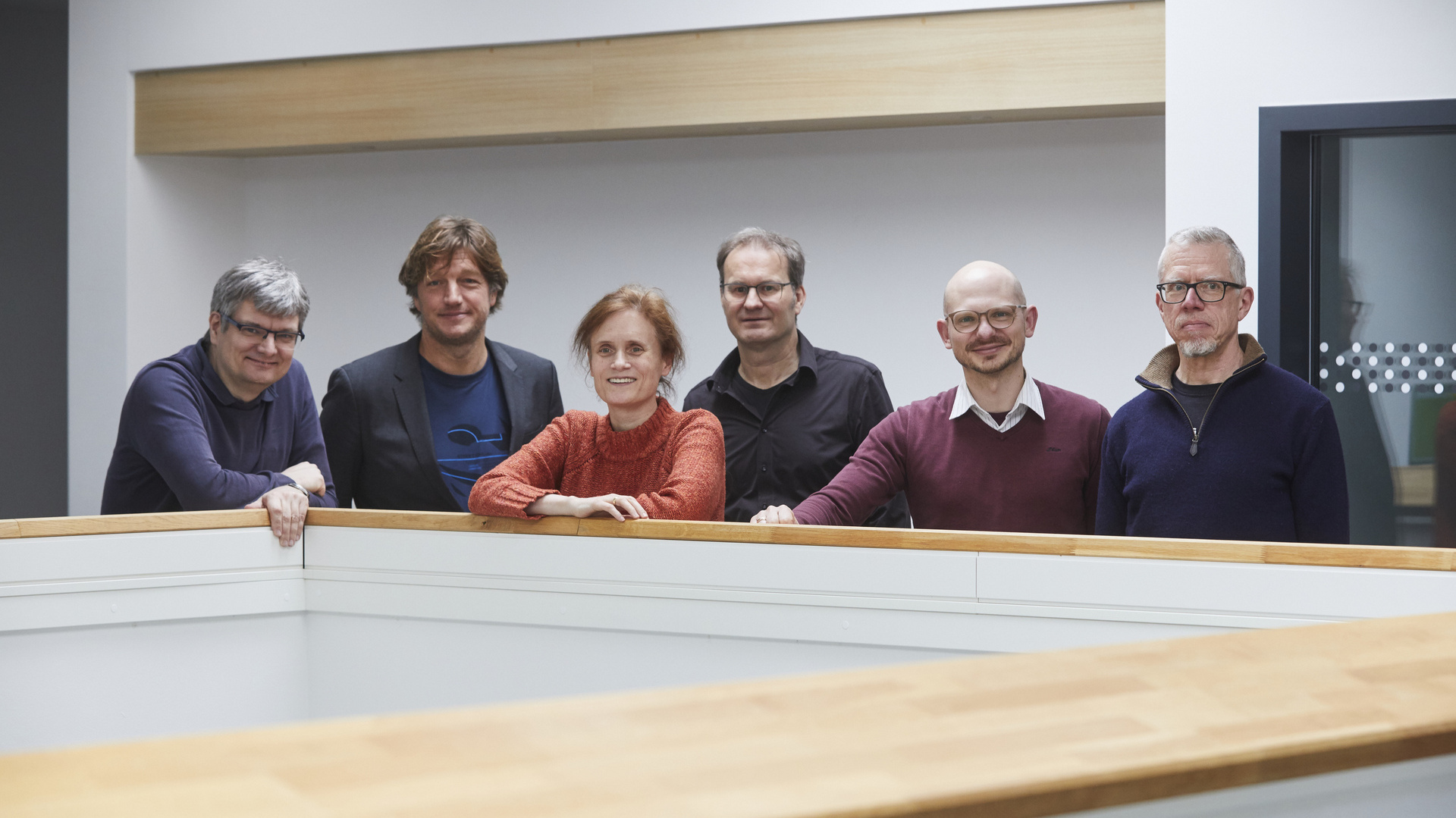
Cooperative work of the NWF research group
Funding as part of the DFG's large-scale equipment initiative
Work is currently being carried out as part of the DFG's large-scale equipment initiative "Time-resolved high throughput imaging of membraneless organelles for organ models" (GZ: INST 168/4-1).
Summary of the project:
The secure supply of the population with established and newly developed drugs is essential for ensuring a functioning healthcare system and is currently the focus of public interest due to supply bottlenecks.
h_da is researching the development of new concepts for the discovery and production of active ingredients using sustainable processes. As part of the DFG Research Impulse Program (FIP), the expertise of eight working groups from three departments has been pooled in order to make the drug discovery process more sustainable. We are applying for a high-throughput microscope in order to optimize the new methods for drug screening, to expand other methods that are important for clinical translatability, such as organ-on-a-chip systems, and to enable the systematic, standardized characterization of biomolecular condensates.
Biomolecular condensates are currently in the spotlight of biochemical and cell biological research. Many processes appear to be regulated by this form of compartmentalization in cells. However, there is disagreement about the relevance of biochemical observations for cell biological processes. This could be improved by standardization and a systematic analysis of the conditions under which the condensates form. We want to make a contribution here by establishing a platform for the investigation of biomolecular condensates with high-throughput microscopy, which is available to the entire scientific community. By comparing results from different laboratories over an extended parameter space, we will gain a better understanding of the phenomenon and its biological significance. Building on this, we will use the platform to develop active substances and drug conjugates (e.g. with nanoparticles) that (de)stabilize or detect these structures.
In addition, organ-on-a-chip systems are to be developed with the microscope to be acquired, which can be used to investigate the interaction of nanoparticles with cell systems, among other things. In the future, such methods could significantly reduce the number of animal experiments in drug development and thus make the process more sustainable. Furthermore, by using human (patient) cells and mimicking (patho)physiological conditions, these models help to improve the clinical translatability of preclinical data.
The new research infrastructure will radiate into large parts of h_da (e.g. the departments of Polymer Engineering, Computer Science, Mathematics and Natural Sciences and Media) and contribute to increased collaboration with working groups at TU Darmstadt. Collaboration with working groups at ETH Zurich will make a valuable contribution to the internationalization of h_da and offer new starting points for future research cooperation.
Work program
Several detailed questions will be worked on together under the following thematic focuses:
- Systematic analysis of biomolecular condensates
- Organ-on-a-chip microfluidic systems and organoids in drug discovery
Person responsible for the application:
Neumann, Heinz, Darmstadt University of Applied Sciences (Biochemistry)
Other persons involved in the application (fields of work):
Becker, Michael, Darmstadt University of Applied Sciences (cell biology)
Graf, Christina, Darmstadt University of Applied Sciences (nanotechnology, physical chemistry)
Meyer-Almes, Franz-Josef, Darmstadt University of Applied Sciences (physical biochemistry)
Schael, Frank, Darmstadt University of Applied Sciences (microprocess engineering, chemical reaction engineering)
Weinmann, Andreas, Darmstadt University of Applied Sciences (image analysis methods)
Barral, Yves, ETH Zurich (biochemistry)
Weis, Karsten, ETH Zurich ( biochemistry)